Monthly Archives: May 2010

17 Million Dollar Tool

DSCN0027  By Rena

 Last week I received a phone call from the local reporter.  She wanted my reaction to the grant that Washington state was going to receive that teachers statewide would benefit from.  I hadn't heard anything about this, so she filled me in.

Recently U.S. Senator Patty Murray (D-WA) applauded the announcement of a major investment to improve education throughout Washington state by giving educators the resources they need to use data to improve student outcomes.  Washington state will receive a grant of over $17 million to further develop the state longitudinal data system (SLDS), funded through the American Recovery and Reinvestment Act (ARRA) of 2009, which will be used to develop data systems used to give educators insights into their teaching practices.  Senator Murray led the delegation in sending a letter to the Institute for Educational Sciences in support of Washington State Research and Data Center, a unique organization that was created to integrate education and workforce data systems.

Continue reading

Graduation. Or not.

 Images by Brian

Our high school graduation is two weeks away, and it looks like Jake (not his real name) will make it. Jake is in my Algebra class this year, and he needs to pass it because he did not pass the state math test.  The rules say that he can graduate anyway as long as he has taken, and passed, additional math classes in his junior and senior year.  Whether or not he passes those classes is a decision that the teacher makes, based on his own standards and knowledge of his students.  Two weeks ago Jake quit coming to school.  It looked like he was going to drop out, a month before graduation.  Then last Thursday his girlfriend talked him into coming back and trying to finish. He came into my room after school and asked me if there was any way he could still pass.  He said he knew he could catch up in his other classes, but Algebra was the one he was worried about. It was why he got discouraged and quit coming to school.  I could say yes, you can pass, because it is still my decision to make.  

Continue reading

Conversations with Arne

FYfLwk  By Mark

The education blogs lit up recently about a technologically-botched conference call between a group of accomplished teachers and USDE bigwigs (including Big Arne), and Duncan's subsequent personal calls to Anthony Cody and Marsha Ratzel, two of the educators who lead the outreach from teachers to the USDE. After reading Cody's descriptions of the conference call and the follow up phone call from Arne, I came to the same conclusion that many other teachers have:

They may be hearing us, but they're certainly not listening.

Continue reading

Merit Pay: Motivation Wall Street Style


Pn_3966_Image_Trading-Floor1-10.19.1987 By Tracey

Yesterday I took my students to the beach at low tide. I participated in the Ocean Science grant with the Seattle Aquarium – a wonderful program if you ever get the chance. We have been learning about ecosystems, food webs, plankton, and our dependence upon the ocean. The students had a terrific time. And, they were interested in the animals. They were even kind and gentle with them. It was one of those proud moments you sometimes have as a teacher where you see some of your hard work pay off. The docent even complimented me. She said that in her job she sees a lot of classes and teachers, and she could see that I was a good teacher because of the way that I handled my students. I got that warm fuzzy feeling you get. I’ll take a compliment. But, don’t let her see my students’ test scores. 

Continue reading

Keep going.

By Tom

I went for a bike ride recently in Eastern Washington. It was a pleasant, sunny day and I was riding alone on a quiet, country road into a scenic canyon. After an hour or so of gently rolling hills, I began to notice that the canyon walls were steadily closing in around me, and the lazy river that I'd been following was starting to take a more active attitude. Things were getting steep. Now, anyone who's ever ridden into a canyon can tell you that there's only two ways out: the way you came, or up the hill at the end of the canyon. And what a hill it was; steep switchbacks as far as the eye could see. I could have turned back; there was no one around to impress, and there were plenty of flatter roads to choose from.

I decided to go for it. It was difficult, grueling and painful. But I eventually made it, and when I got to the top I was exhilarated. I had successfully done something difficult. I also found that the rest of my ride was defined by my decision to take the climb. I got to spend the next two hours going generally downhill, and the slopes I did encounter paled in comparison to the monster I had climbed earlier. It was well worth the effort.

As I was coasting along, I began to reflect that this experience was not unlike how it is in education today. For the first 25 years of my career, things have been going relatively smoothly. I've felt respected and supported by the press, the policy-makers and other stake-holders. But things right now are as discouraging as I've ever seen. We've got climbing class sizes, RiFs, lower funding, program eliminations, heightened accountability, ridiculous merit-pay schemes, wholesale faculty firings; not to mention climbing healthcare premiums and retirement account statements that we don't even want to look at. And to top it all off: copy counts! We're getting in trouble for producing the very materials we need to do our jobs. An outrage!

I feel like we're at that hill at the end of the canyon. Some of us are tempted to turn around and ride back out. Most of us, however, are plodding on, even accelerating, despite the slope. Why? because we know we're supposed to. We know we're doing something important. Something that needs to be done, no matter how difficult it seems.

And we'll do it. We'll get over this hill. Not right away, but eventually. The funding will return, the pressure will ease and class sizes will come back down. The good teachers that got Riffed will come back and we'll get to use the copier when we need to.

And just like my bike ride, we'll find that the next decade or so will be defined by the way we deal with things right now. If we quit on each other, quit on our students and quit on ourselves, we'll have lost; we'll have taken the easy road out. But if we stick together, focus on our students and stay true to what got us into this wonderful profession in the first place, we'll be fine. We'll look back on this period knowing we took the tough way out. We'll know we climbed the hill at the end of the canyon.

I'll end with a line from Winston Churchill, who was talking to a far more discouraged group during a far bleaker period of time:

"When you're going through hell," he said, "Keep going."

Management

4YLXZa  By Mark

I've managed to have a pretty successful career so far. I've earned some awards, National Certification, recognition. Like many of us, I have those kids that come back and call me their favorite teacher, sometimes offering unfair or unkind comparisons to subsequent teachers who the student disliked. But I've had an internal struggle about where my success is rooted, mainly because I am, without contest, the least well-read English teacher (let alone department chair) to ever hold the title. In lofty discussions on the fringes of department meetings or around the lunch table, when the topic turns to high literature, grand philosophy, or big names, if I don't physically retreat, I do so into my own little mind hoping and praying no one asks for my ideas on the Bacon/Shakespeare authorship debate or what I think about hermeneutics or philology.

Sure, I managed to get a degree in English from a university. But I only read what was assigned–and though I did so with dedication and interest–I've never really been a bookworm, even though I am a strong proponent of helping my students channel their inner bookworm. What I do think makes me an effective teacher seems to appear nowhere on any of the rubrics or standards for effective teaching. When I did my National Boards, it wasn't there. When I look at models of merit pay, its not there. Aside form the rubrics by which my recent student-teacher was assessed (and even there it was vague), I've not seen it anywhere.

Continue reading

The Burden of Leaving No Child Behind

Photo0278 By Kristin

I understand the urge to compare the best charter school to an average public school and then argue that if one can work miracles, the other should be able to.  And I understand that if a bright-eyed Princeton graduate can go down into the depths of Mississippi and get her second graders to read Antigone – and love it – then I should be able to get my habitually-truant tenth grade gang-banger to pass the state assessment.  So, to be clear with where I stand on things, I support the push to evaluate schools and make sure they're effective at what they do.

But let's be honest.  Most public schools don't have the luxury of focusing solely on academics.  I hear a lot about how we're the wealthiest nation and yet we have high school juniors who can't write well, but I don't hear enough about the fact we have children who, because of catastrophic brain damage or learning deficits, spend their days in a safe, engaging, therapeutic environment paid for with tax dollars.  These are tax dollars set aside for public education, but really they're spent on the kind of education that doesn't match up to Race to the Top values.  I think Arne Duncan, Jon Schnur and Wendy Kopp should remember that the role of public education doesn't begin and end with academics.

Continue reading

How to Handle This One? (Westboro Baptist Church)

DZdreV

By Mark


A friend of mine in Clark County (Washington) sent me this link
from the local newspaper
 which details that the Westboro
Baptist Church, a Kansas-based group known for its frequent anti-gay protests
as well as protests at military funerals, will be targeting a school in the
district neighboring hers.


From the article:

No one’s sure why the Orchards school was singled out for a
30-minute demonstration, which would be the notorious group’s first in Clark
County… Early June 1, the group will picket Portland’s Grant High School
before the first bell, the [Westboro Baptist Church] website shows. That
same day, it will gather at Heritage from 2:15 to 2:45 p.m., chiefly “to picket
the rebellious brats and lying teachers,” the website explains.

I'm curious to see how the school, and the students, handle
this "constitutionally protected exercise of free speech." If you
knew this group was coming to your school, how would you recommend that your
school, students, and community respond? 

And there are so many other questions I'd love to ask…but
this blog is probably not the appropriate forum for them…so let's focus on
how teachers, administrators, students, and the community can best respond to
this provocative and potentially volatile situation.

Racing to the Trough?

by Brian
Pig_trough
 

Today the drumbeat continued to have school districts in Washington sign the state application for The Race to the Top funds.  In the Seattle Times, Brad Smith of the Washington Roundtable writes: "By making a strong show of support for Washington's application today,
districts increase their chances to receive additional funding for
reforms they will need to implement tomorrow."

A Tacoma News Tribune editorial writer encouraged districts to sign the RTTT application, and applauded the Peninsula School District, saying: "So don’t count Peninsula among the districts that can’t be bothered to
accept a check for improving their instruction."

But the Columbian struck a different tone in their editorial: In our view: 'Race to the Trough'? They quote La Center Superintendent Mark Mansell as saying, “Any time you chase money
and not an idea, it’s not meaningful change. It has no real impact.
That’s the thing that makes me really, really upset about this. We’re
chasing after the money.”

Continue reading

Driven by Money?

By Tom

Never mind the fact that we can’t afford it. And set aside for now the reality that it’s ridiculously complicated and incredibly unfair. The most important question to ask about merit pay is the one we should have asked in the first place: Does it work? Do people actually perform better when they know that the results of their efforts are directly tied to their salary?

Well, apparently not.

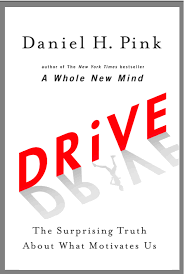
I just finished an outstanding book by Daniel H. Pink called Drive: The Surprising Truth about What Motivates Us. He makes a compelling case that most of us are absolutely not driven by the desire to make money. Especially those of us who work in fields where we’re required to make decisions and solve problems. Like teachers.

Continue reading