Category Archives: Uncategorized

If money were no object, here’s how I would improve our education system:

1966 Baltimore Orioles Home Jersey From Mitchell & Ness, With #5 On Jersey (Brooks Robinson)Tom's Five:

1. Lower class sizes. If there's one way in which teaching is different than most other professions it's this: We work with a lot of other people simultaneously. Doctors, lawyers, accountants and others are also very busy people, but for the most part they only work with one client at a time. Most teachers work with 20 to 30 (or more) students at the same time. I will work just as hard with the 27 students in my classroom as I would with the sixteen that I wish I had. I will get up just as early, work just as late and be just as tired when I go to bed. Doesn't matter to me. But 1/27 of my time and energy is a much smaller fraction than 1/16.

Continue reading

Five ways education could be improved…

Singlewide By Mark
 
My family growing up used to joke that we were so accustomed to living with few excesses that if the numbers came out right, we'd be the only lotto winners in history to use the money to buy a nicer trailer instead of a mansion.
 
That memory came to mind, for some reason, when the SFS bloggers were asked to write about what they would do to fix education if money was not an issue. We're used to operating within humble means in the public schools, so I figure that the changes would be small but meaningful. If public education were not bound by dollars or entrenched paradigms, we could fix the system by simply following through on our promises.

Continue reading

Countdown to Launch


Clock

It's August, which means Stories from School: Practice meets Policy is returning! Travis, Tom and Kim are back, along with a great group of new blogger colleagues. Readers can get a sneak preview by reading their bios now, located in the left hand column of this page. Then get ready. Each blogger is set to ready to connect practice and policy with a bold first post, "Five Ways I Would Change Education if Money Was Not An Issue." You'll be surprised about the ways in which they'd transform education funding. Stay tuned!

Tracey

Somewhere in my 13 years of teaching, I crossed over the hump of being a new teacher to becoming a veteran teacher.  I’m not exactly sure when this happened, as each year still feels new and adventurous to me.  But as a teacher of more than a decade, I’ve watched how decisions made by others outside the classroom affect my students.  Not all of those decisions have ruffled my feathers; many of them have been very positive and have enhanced my instruction and student learning.  I’d like to think that I haven’t developed that jaded look I saw in the veteran teachers that helped ease me into the profession. I try always to stay open-minded, thoughtful, and listening.  But, sometimes I catch myself.  You can help by joining in the dialogue.  I hope you do.

Apart from a three-year stint of teaching first graders, I mostly teach the intermediate grades in elementary.  Right now, I teach 5th graders in SeaTac, Washington.  I came into teaching after being an exchange student in South Africa during Apartheid.  At the time I was a senior in high school, applying to colleges and universities, trying to figure out what I wanted to do with my life.  I thought I wanted to get a degree in international relations and become an important diplomat or, maybe even an ambassador. But, living there for a year made me realize that change starts with your community.  I figured that I was not particularly special, or different from anyone else, and if I had grown up in a white South African family, my ideas about racial segregation would mimic theirs.  My “enlightened” ideas were merely the result of my environment -my upbringing and my education.  This realization led me to think that teachers are very influential people, and if we want to help make our world a better place, we need good teachers.

I didn’t go right into education; this realization took some time and some suggesting from my then boyfriend, now husband of 18 years.  He knew I should become a teacher long before I did.  In college I double-majored in history and political science from the UW and earned my masters in teaching from Seattle University.  I stayed in school as long as I could.  I told people that it was because I looked young  — when volunteering in an elementary school, I got yelled at by a teacher who thought I was in middle school.  I used that as an excuse to stay in school longer before entering the classroom.  But, the truth is, I just loved school and loved learning.  What I didn’t know was how much that would follow me into the classroom.  

Adventure and learning are what keep me inspired as a classroom teacher.  Each new class of students brings a new set of challenges and discoveries.  Together, we explore the world around us.  The marvelous thing about exploring the world from our classroom is that it never looks the same.  Each year, with different eyes and different experiences, the content always winds up being different.

My posts to this blog will most likely reflect this deep-held belief of mine that students have to care about what they are learning.  They have to feel an eagerness to discover. While learning basics skills is a positive and necessary outcome, my hope is for it to happen serendipitously on the search for something big and meaningful- something that will keep my students hungry for more.  If I can do that, I’ll be doing my job.

Kristin Bailey-Fogarty

I teach a reading intervention class at a middle school in Seattle.  I’ve taught 7-10th grades, history and LA, honors and standard.  I’ve taught in the city, where I live, and in the suburbs.  Change is important to me – every few years I get the itch to teach something new or teach a different age or demographic of student.  I’m also a mom, and a gardener – two roles that inform the decisions I make in the classroom.

July

Images Thanks for visiting Stories from School: Practice meets Policy.  We are on hiatus for the month of July so that SFS bloggers can spend time thinking exceptionally big thoughts. Have no fear though, SFS posts are still accessible during this time through the archives or on Twitter. We will return in August, charged up and ready to go. Be ready to read new ruminations from your favorite SFS bloggers, plus get to know a whole new group of accomplished teachers who are ready, willing and able to connect practice and policy.

Thanks SFS community, for a great first year.

Year two is going to be interesting!

Teaching is Unique

Picture 2

Teaching is a unique profession. Certainly for the reasons
you think—squirrelly kids, parents, bells. However, there is one more reason. A
reason that is dear to all teachers, and likely something you would only
know if you were a teacher . . . . or were told. And I am about to tell you.

Continue reading

Are Charter Schools the Answer?

By Tom

I use a lot of small group activities in my classroom. After I teach a concept, I like to put my students into groups of three to do an activity in which they get a chance to discuss the concepts and practice the skills I've taught them before I ask them to demonstrate their learning individually. It's a strategy that works pretty well.

To get my students into functional groups, I'll get out my set of Popsicle sticks, each with a student's name printed on it. Then I'll divide my sticks into three groups; the group on the right represents the kids who I expect will have understood the concepts and skills, as well as the instruction for the activity they'll be asked to do. I'll be counting on them to be the leaders in their group. The sticks in the middle represent the kids who may or may not go into the activity with a complete understanding of the material. I'm hoping that the chance to process it with their peers will complete their understanding. The sticks on the left are the kids who will probably need the most support. Hopefully, hearing their peers present the information in a different way and in a small group will fill in the holes for these students. After dividing the sticks into three groups, I'll form my groups by picking a stick from each pile, with consideration for who does and doesn't work well together.

A few years ago I had a student named Laura. Her stick was consistently in the pile on the right. She was a bright, hard working kid who also possessed great communication skills. She knew how to express her ideas without being bossy, and she knew how to listen to other people without compromising the correct answers. She was an ideal student. She was also extremely talented in music, playing first violin for the local youth symphony when she was only in third grade. 

And it didn't end there. Her dad was a hard-working engineer-type who kept her motivated and well-practiced in regards to music, and her mom, a nurse who had taken a decade off from her career to raise the family, was the backbone of our PTA, volunteered twice a week in my classroom (the only volunteer I had!) and chaperoned on every field trip. This was a family committed to their children and their school community.

But then they left. Our district has a choice school. One where each parent has to commit to several volunteer hours each week. It's a great school, with great teachers, motivated students and supportive parents. Not surprisingly, due to the miracle of self-selection, the test scores are in the stratosphere.  They hold a lottery for their openings, and Laura won.

Continue reading

State of the Union?

By Tom


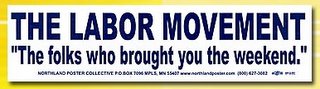
When I received my first public school paycheck over two decades ago, I looked it over carefully. Noticing that a large chunk of change went to my union, I asked around and found out that being in the union was optional. So I called the union office to see about "unjoining." Although happy to help, they also mentioned that, should I decide to opt out, I would instead be coughing up roughly the same amount for an "agency fee," paid to the union as compensation for reaping the benefits of the union's collective bargaining agreement.

I complained to my father, hoping for some sympathy. As a city manager, he had spent a career across the table from the police and fire fighter unions and it wasn't always fun. But instead of sympathy, he sat me down for a quick history of the organized labor movement in this country. Then he told me I was lucky to be in a union, and if I had any problems with it, I should get involved and make it better.

So I did. I can't say I've made the union "better," but after many years in many different roles I certainly have more respect for the union that represents us. 

I also worry about it. This has been a tough year for all of us, and the teachers' association has taken a lot of criticism.

Continue reading