by Travis
Why don't all teachers blog? It seems reasonable to think that a great many do. Teachers like to share and the internet allows for such ease in sharing. However, I wonder how pervasive teacher blogs are.
by Travis
Why don't all teachers blog? It seems reasonable to think that a great many do. Teachers like to share and the internet allows for such ease in sharing. However, I wonder how pervasive teacher blogs are.
 By Tom
Quick, what's eight-ninths of twenty-seven? If you solved it like my third graders, you divided the total by the denominator and then multiplied by the numerator. 27 divided by 9 is three; three times eight equals 24. It's pretty easy, right?
Actually, no it isn't. At least not for third graders. For my students, that problem was fairly difficult. Rigorous, if you will. It was a hard lesson to teach, but most of them finally got it.
Our district switched to a new math curriculum this year. It's more rigorous. Way more rigorous. And that's a good thing, according to all the school reform gurus, including Arne Duncan, our new Secretary of Education. He wants to implement high, nation-wide standards in lieu of the piecemeal, state-by-state approach that we're using now. He also thinks we should have a longer school year, which in an astounding display of poor timing, he announced just last week.
Meanwhile, back in my district, we had to cancel summer school this year. Guess why? That's right, as soon as we switch to a tougher math curriculum, we find out that we can't afford to offer summer school for the kids who need more time to learn it.
So here's an idea:
Teaching is a unique profession. Certainly for the reasons
you think—squirrelly kids, parents, bells. However, there is one more reason. A
reason that is dear to all teachers, and likely something you would only
know if you were a teacher . . . . or were told. And I am about to tell you.
 By Tom
I use a lot of small group activities in my classroom. After I teach a concept, I like to put my students into groups of three to do an activity in which they get a chance to discuss the concepts and practice the skills I've taught them before I ask them to demonstrate their learning individually. It's a strategy that works pretty well.
To get my students into functional groups, I'll get out my set of Popsicle sticks, each with a student's name printed on it. Then I'll divide my sticks into three groups; the group on the right represents the kids who I expect will have understood the concepts and skills, as well as the instruction for the activity they'll be asked to do. I'll be counting on them to be the leaders in their group. The sticks in the middle represent the kids who may or may not go into the activity with a complete understanding of the material. I'm hoping that the chance to process it with their peers will complete their understanding. The sticks on the left are the kids who will probably need the most support. Hopefully, hearing their peers present the information in a different way and in a small group will fill in the holes for these students. After dividing the sticks into three groups, I'll form my groups by picking a stick from each pile, with consideration for who does and doesn't work well together.
A few years ago I had a student named Laura. Her stick was consistently in the pile on the right. She was a bright, hard working kid who also possessed great communication skills. She knew how to express her ideas without being bossy, and she knew how to listen to other people without compromising the correct answers. She was an ideal student. She was also extremely talented in music, playing first violin for the local youth symphony when she was only in third grade.
And it didn't end there. Her dad was a hard-working engineer-type who kept her motivated and well-practiced in regards to music, and her mom, a nurse who had taken a decade off from her career to raise the family, was the backbone of our PTA, volunteered twice a week in my classroom (the only volunteer I had!) and chaperoned on every field trip. This was a family committed to their children and their school community.
But then they left. Our district has a choice school. One where each parent has to commit to several volunteer hours each week. It's a great school, with great teachers, motivated students and supportive parents. Not surprisingly, due to the miracle of self-selection, the test scores are in the stratosphere. They hold a lottery for their openings, and Laura won.
I read an article a couple of weeks ago that really caught my attention. Unfortunately, when I went back to it – or at least TRIED to go back to it, I couldn't for the life of me remember where I had read it. Darn. It was about the use of technology in the classroom and how, if we aren't careful about how we use it, we might actually be doing more harm than good to our students' ability to think critically.
What technology and the use of the internet can give us is instant access to amounts of information so vast that our ancestors couldn't even have dreamt of it. Yes, I am a Google fanatic, and even as an English teacher who refuses to spell "relief" any other way, I have been known to use "google" as a verb. However, when I recently assigned my students a research project, I was reminded of how dismaying it is to see how they confuse "finding information" with "thinking" and "learning." They are great at cutting and pasting information into beautiful PowerPoint presentations or blogs or webpages. What this lost article pointed out and what I have fought against in my classroom is the ease with which technology negates the need to actually think. I require that for every sentence of fact, students are required to present two sentences of their own analysis, but often students are willing to settle for a lower grade in order to avoid the "pain" involved in activating their brain.
It reminds me of a conversation I once had with one of my daughter's elementary school teachers who felt it was unnecessary to require kids to memorize the multiplication tables or spelling lists because they would always have access to calculators and spell check programs. I tried to explain how understanding the concepts underlying the equations and word structure was just as important as being able to solve the equations or spell the words correctly, but she was in complete disagreement, stating that there are plenty of other areas where the kids can be asked to "think," and that if we skip some of the rote memorization, we can move on to more and better concepts. I understand the point she was trying to make, but recognizing patterns in equations or word formation is basic to analysis of any kind.
While we're touting the use of technology as "best practice," we have to be conscientious that we are not substituting flashy presentations and clever sound bites (or bytes) for true critical thinking, which is fundamental to the success of civilization.
P.S. If anyone read that article and could lead me back to it, I would greatly appreciate it!
By Tom
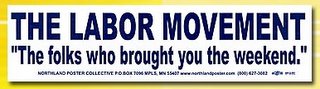
When I received my first public school paycheck over two decades ago, I looked it over carefully. Noticing that a large chunk of change went to my union, I asked around and found out that being in the union was optional. So I called the union office to see about "unjoining." Although happy to help, they also mentioned that, should I decide to opt out, I would instead be coughing up roughly the same amount for an "agency fee," paid to the union as compensation for reaping the benefits of the union's collective bargaining agreement.
I complained to my father, hoping for some sympathy. As a city manager, he had spent a career across the table from the police and fire fighter unions and it wasn't always fun. But instead of sympathy, he sat me down for a quick history of the organized labor movement in this country. Then he told me I was lucky to be in a union, and if I had any problems with it, I should get involved and make it better.
So I did. I can't say I've made the union "better," but after many years in many different roles I certainly have more respect for the union that represents us.
I also worry about it. This has been a tough year for all of us, and the teachers' association has taken a lot of criticism.
This past week, our district was not exempt from the RIF’s that have been making the news in education. We are losing four young, bright first-year teachers who have brought enthusiasm and innovation to their jobs.
In the background are some more “veteran” teachers who have refused to change with the times. In spite of the changes in society and technology, they teach the same way they have taught for years, holding on to their jobs out of habit rather than passion. They move through the curriculum by rote, paying little attention to whether or not the students are responding. Their evaluations haven’t been top notch, but their jobs are safe.
Then there are a few teachers who simply don’t get it. They want to be “friends” with the kids, or they care more about the content than the kids. The discipline referrals coming out of their classrooms are numerous and would be unnecessary with better management. Their evaluations haven’t been top notch either, but their jobs are safe.
I know that this is a very, very difficult question – especially in these hard economic times. (Maybe the question should be, "Is the State making the best budget decisions right now?" – but that's a different discussion.) However, with all of the pressure being put on teachers to meet professional standards through reflection and best practices, shouldn’t the teachers who are doing that have some advantage?
 By Tom
I flunked a kid today. Held him back. Retained him. It was as bad as you can imagine, only a little worse. Getting held back is a big deal to a third grader, and we don't take it lightly.
Our meeting was set for 2:30, the afternoon of a non-student day, arranged after a series of emails and phone calls designed to lay the ground work. Of course, the decision itself was the result of a lot of processing and agonizing, trying different interventions and new strategies. And I know in my heart that it was the right decision.
Still, I woke up this morning in a horrible mood.
By Tom
My class took the WASL last week. Things were going well; I had an ample supply of fresh pencils, a different snack every day, we had completed the practice tests full of retired prompts, the parents were told the benefits of proper nutrition and adequate rest. I had done everything I was supposed to have done to prepare my students. Or so I thought.
By Tom
Finally finished
documenting all of my
professional growth!