How much do you value student voice? By the term “student voice” I am referring to the values, beliefs, opinions, and perspectives of the students in our classrooms. I think we all instinctively understand that student voice is important, but do we value it so much that we intentionally make room for it? Do we value it as much as we value teacher voice in the classroom?
This year, I am focusing on creating relationships that promote social emotional learning. I have become increasingly aware of what students are saying, and, consequently, of what teachers are saying about their students. Although I am finding the student voices in my classroom to be informative and invigorating to the learning environment, it is clear that some educators are often frustrated with what students have to say.
Personally, I find joy in my classroom listening to the voices of my students. Every day I learn something new. Every day I laugh. My students bring life to my classroom and they fill my days with their varied perspectives, diverse backgrounds, interesting opinions and wild imaginations. My walls display their work. My units shift and change with their contributions and preferences. Every time I read a novel with a class, I see it through different eyes and hear it through different voices. Every time I give them a controversial topic to discuss, I hear a new perspective and learn a little more about their generation and our community. Continue reading


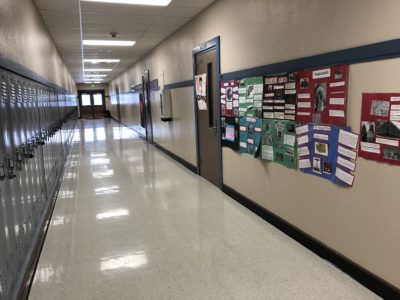 As an educator in a rural district, I have spent many years observing how our students often have less access to the options that are readily available in larger and urban districts. For instance, in addition to fewer electives, we offer few opportunities for students to take AP or dual credit courses, forcing many of our best scholars to travel forty miles to a community college as Running Start students. Additionally, where other districts had classes to support students who failed the state assessments in math or language arts, we did not have the resources or staff to offer such dedicated courses. Instead, because we are committed to our kids, our staff has worked outside of the regular schedule to support them and create Collections of Evidence or prep for test retakes.
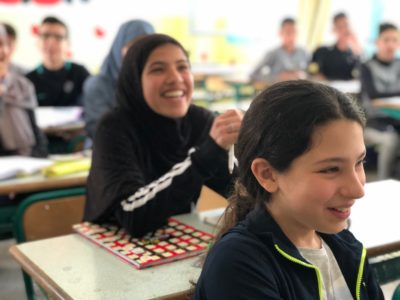
 How many times have you groaned about sitting through professional development? How do you feel about a parade of presenters telling you yet another way you can do your job? Do you get excited about trainings? About conferences? About the newest in education-related publications?
 “Yes, and…”, also referred to as “Yes, and…” thinking, is a rule-of-thumb in improvisational comedy that suggests that a participant should accept what another participant has stated (“yes”) and then expand on that line of thinking (“and”). It is also used in business and other organizations as a principle that improves the effectiveness of the brainstorming process, fosters effective communication, and encourages the free sharing of ideas.” (For a good article that explains it more fully along with videos, go
 Shameless plug time: There is an amazing learning opportunity on our horizon. The Washington Teachers Advisory Council is hosting their third conference next month. This conference takes place at beautiful Cedarbrook Lodge in Seatac on May 4th and 5th. Lodging included, it will cost you only $100-125 to attend, which is a steal! At this conference, you will encounter an all-star lineup of presenters, panelists, and speakers, including 2019 WA Teacher of the Year Robert Hand and 2018 National Teacher of the Year Mandy Manning. Sessions will include topics like transforming special education inclusion practices, educating to advocate, innovating education with STEAM, social emotional learning and character education, and much more.
 Trauma is a beast with multiple personalities. It can slink in the classroom, with downcast eyes and arms crossed; hoping to be unseen. It can also fling itself through the door, announcing its energy in bubbly, overly helpful behaviors that cross the border frequently into bossy and inflexible, resulting in a lonely child bewildered by her lack of friends. Trauma can be tired, unfocused, quick to be red-faced angry, fidgety and/or slack-bodied. All within a single day! Trauma is exhausting and confusing, not only for children, but for teachers too. That is why I am thrilled that our state is taking a proactive approach to helping BOTH teachers and students to address many of the behaviors that students of trauma present with in our classrooms.
 The new year is upon us, happening too fast, as usual. Just as we get used to the schedule of a Winter Break, we are trying to get a mountain of tasks done before school starts up in a few short days. Where does the time go?
 As I write this, my home is filled with the savory aroma of black-eyed peas, collard greens, and pork. It’s a tradition in our family, and in many places around the country, to eat black-eyed peas on New Year’s. It’s for luck and prosperity in the new year.
  Oprah Winfrey often talks about the one thing every person truly wants; to be seen and to be heard. This makes sense and can impact your classroom when kept in mind while teaching. It turns out it can impact whole groups of people when applied to policy making.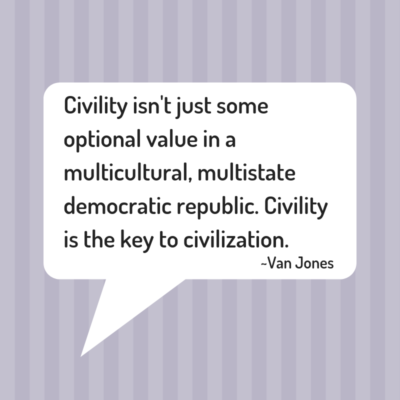
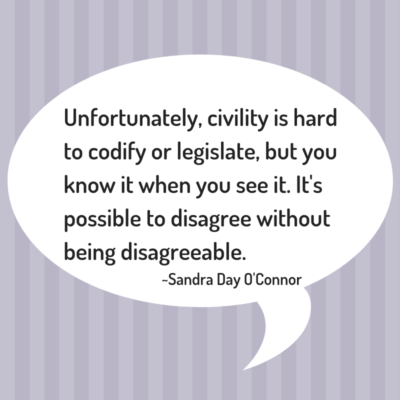 Civil discourse is the engagement in conversation to enhance understanding. It requires respect for all others involved, without judgment. You cannot conduct civil discourse if it is obvious that you question the good sense of your peers. You cannot conduct yourself with hostility, sarcasm, mockery, or excess persuasive language. You have to accept the views of others as valid, despite your disagreement.
 As teachers, the urge to stay out of it, to be apolitical and neutral is strong. We don’t want to offend our students, their families, or our communities. However, we must model that we all have views and ideas, and how we express them is important. We do not force our views on others, but, instead, we invite discourse. Our students need to learn to share their ideas and listen to their peers. They need to understand the importance of researching the issues and verifying their sources. They need to practice protocols of debate and dialogue that guide them to be supportive listeners, even when they disagree.